Crypto Signals Without API Keys

One of the fastest ways to trigger skepticism in crypto is to ask a new user for exchange API keys before trust has been earned. That skepticism is justified.

Many traders want help with signal discovery, trade structure, and alert delivery without handing account access to a third party. That is exactly the use case SniperSignals is built for.

SniperSignals does not require exchange API keys. Your funds stay on your exchange. Signals are delivered through the product workflow and Telegram rather than through direct account control.

If you want crypto signals without api keys, the core benefit is simple: the service can show you opportunities without asking for control over your account. SniperSignals combines dashboard context, Telegram delivery, and public signal history while keeping your exchange account separate.

Start Free 7-Day Trial

No credit card required. No API keys.

Why API-key fear is rational

Handing API keys to a third party means giving some level of access to your exchange account. Even read-only keys expose balance and position data. Trade-enabled keys go further. In crypto, that is not a theoretical concern. Traders have lost funds or sensitive account visibility through compromised services, phishing scams, weak storage practices, and badly secured platforms.

That is why API-key fear is not paranoia. It is pattern recognition. This market has a long history of shortcuts being sold as convenience while risk gets pushed onto the user. When a new service asks for exchange credentials before trust is established, many traders immediately assume the downside is larger than the upside. In a lot of cases, that is a rational read.

The safer baseline is simple: separate signal delivery from account control. If a product can help you discover setups, understand context, and act faster without requiring privileged exchange access, that is a cleaner trust model from the start.

What SniperSignals does instead

SniperSignals delivers signals through the product dashboard and Telegram. The system tells the trader what it sees: direction, signal timing, workflow context, and the surrounding market regime conditions. The trader then decides whether to act and executes on their own exchange account.

There is no connection between SniperSignals and the trader’s exchange account. No API keys, no OAuth, and no account linking of any kind. That separation is deliberate. The product’s job is signal discovery and structured delivery, not direct custody or execution.

This also keeps the workflow easier to evaluate. A trader can inspect the public signal history, review how the regime-filtered model works, and decide whether the delivery flow feels useful before paying. The trust threshold is lower because the service is not demanding account access up front.

In practice, this changes the relationship between the product and the trader. SniperSignals can show what it sees, explain the workflow, and let the user act independently. That is a healthier operating model than asking for exchange permissions and hoping the user accepts the risk because the marketing sounds confident.

The product workflow

The signal engine runs continuously across tracked pairs and timeframes. When conditions pass the regime filter, a signal is generated and shown on the dashboard. A Telegram alert is then sent so the trader sees the setup quickly without having to keep the dashboard open all day.

From there, the trader reviews the signal on the dashboard, including the broader context and recent behavior, and decides whether to act. Execution happens entirely on the trader’s own exchange. SniperSignals is the workflow layer, not the account-control layer.
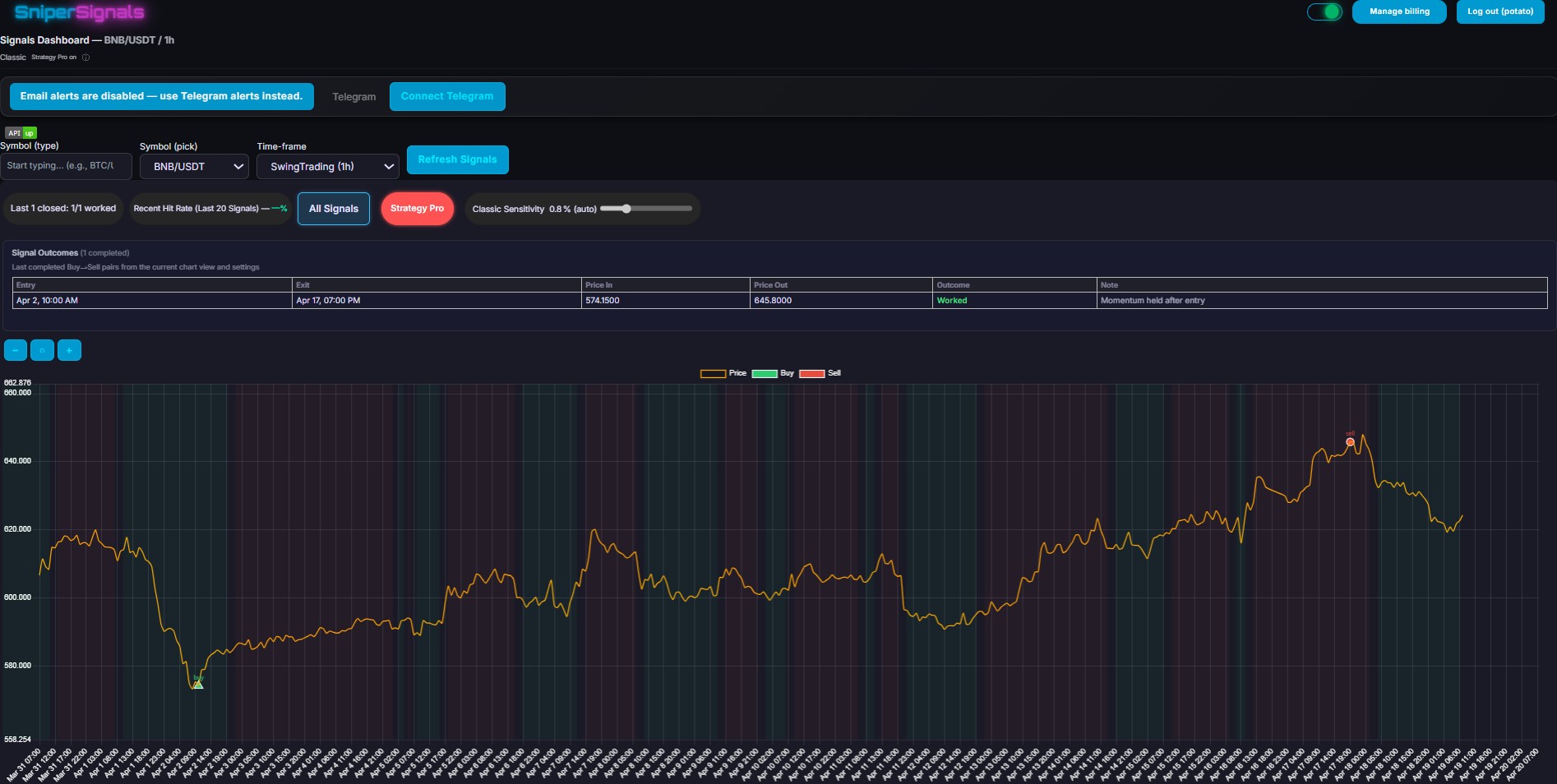
That separation keeps responsibility clear. The product surfaces structured information. The trader decides whether the setup is worth taking. Because the service is not wired directly into the exchange account, there is no confusion about who owns the execution decision or who is actually pressing the button.

That model is also why the Telegram page and the no-API-keys page naturally connect. Telegram is used because it is a fast delivery channel. It is not used as a substitute for product context, and it does not imply direct integration with your exchange account.

Why separation builds trust

In crypto, trust is easier to destroy than to earn. A product that asks for control too early often creates suspicion before it has shown any value. By contrast, a workflow that keeps the trader’s account separate can earn trust gradually. The service can prove it understands the market, show its historical outcomes, and let the trader evaluate the experience without having to surrender credentials.

That is part of why the no-API-keys model matters commercially, not just technically. It lowers the initial resistance because the user does not have to make a major security decision on day one. Instead, they can inspect the public signal history, compare the service with the live regime behavior, and decide whether a free trial is worth starting.

This does not remove all skepticism, and it should not. It simply puts the skepticism in the right place. Traders can focus on whether the workflow is useful rather than on whether they are about to expose their exchange account to a stranger.

Public proof before signup

The public signal history page is available before signup. Traders can inspect past resolved signals, including worked, mixed, and failed outcomes, without creating an account, without paying, and without providing anything beyond the page visit itself.

That matters because it gives people a way to inspect the workflow before moving into a free trial. Public proof is a stronger trust builder than asking people to believe platform claims first and evaluate later.

It also means the no-API-keys claim does not sit alone as a marketing line. Traders can compare the trust model, the product workflow, and the visible record together. That combination is much stronger than a promise of safety with no public evidence attached.

See Public Signal History

Who this is for and who it is not for

SniperSignals is a fit for traders who want structured signal delivery without surrendering account access. If you want help seeing setups, receiving alerts, and reviewing context while still keeping execution on your own exchange, this model fits.

It is also a fit for traders who want a product they can inspect before deeper commitment. The combination of public proof, selective filtering, and Telegram delivery gives you something concrete to evaluate before you decide whether the workflow deserves a longer look.

Traders who prefer independent execution often like this setup because it respects their existing tools and exchange preferences. The product informs the decision, but it does not take over the account.

It is not a fit for anyone looking for automated copy trading, managed accounts, or bot execution tied directly to their exchange. If your goal is hands-off delegation through credentials and automation, this is the wrong model. If your goal is a cleaner signal workflow that keeps account control with you, it is the right kind of separation. You can inspect the public proof first, compare against pricing later, and start with a free 7-day trial when you are ready.

Explore the workflow before committing

Inspect the public signal history, review the regime model, and see how signal delivery works without exchange account linking.

Start Free 7-Day Trial

No credit card required. No API keys. Explore the workflow first.