Last updated: April 2026
How to Verify Crypto Signals Before Paying
Written by SniperSignals — product team focused on transparent signal workflows, public proof, and trust-first evaluation.
How to verify crypto signals before paying starts with one uncomfortable question: what happens to the losing calls? If a signal service can show you screenshots of winners but cannot show you failed signals, mixed outcomes, or recent resolved history in public, you are not looking at proof. You are looking at sales material.
That matters because this market is full of performance claims built on selective memory. A few wins get pinned. A few charts get highlighted. The ugly rows disappear. By the time a trader realizes that the evidence is incomplete, the payment has already been made.
A real evaluation process should be useful even if you never buy anything. That means learning what a public record should show, why screenshots are weak proof, and how to compare signal providers without outsourcing your judgment to hype.
If you want a trust-first way to evaluate signals, start with public signal history, run samples through Signal Verifier, compare how the regime filter behaves, and only then decide whether the workflow deserves a look at pricing.
See Public Signal HistoryWhy hidden losses are the biggest red flag
Hidden losses tell you more than any advertised win rate. If a provider cannot show failed signals in the same system where it shows wins, then the service is asking to be judged on curation rather than accountability. That is the opposite of what a trader should want before paying.
In practice, that usually looks like a Telegram room full of pinned winners, screenshots with no consistent audit trail, and recap posts that focus only on the flattering side of the record. It feels impressive until you ask the obvious question: where are the bad calls?
A service that wants trust should not need that question to be asked. It should answer it preemptively with public proof.
Why screenshots are weak proof
Screenshots are easy to cherry-pick. They remove context, hide timing, and tell you almost nothing about what happened before or after the highlighted moment. A screenshot can support a claim, but it should never be the core evidence behind a paid signal service.
That is especially true in crypto, where timing and execution assumptions matter. If the service cannot show when the signal was posted, how the result was classified, and whether similar setups also failed nearby, then the screenshot is doing too much work and proving too little.
Strong proof looks more like a ledger than a highlight reel.
What a real public track record should show
A real public track record should show wins, losses, and mixed outcomes in one place. It should show recent resolved history, not just timeless claims. It should also make its outcome rules visible enough that an outsider can understand how results are being classified.
At minimum, you should be able to inspect the record before paying, compare it with the product workflow, and decide whether the service is being honest about its own behavior. That is what public signal history is for.
If the provider cannot do that, the burden of proof is still sitting on the buyer.
How to evaluate a signal provider before paying
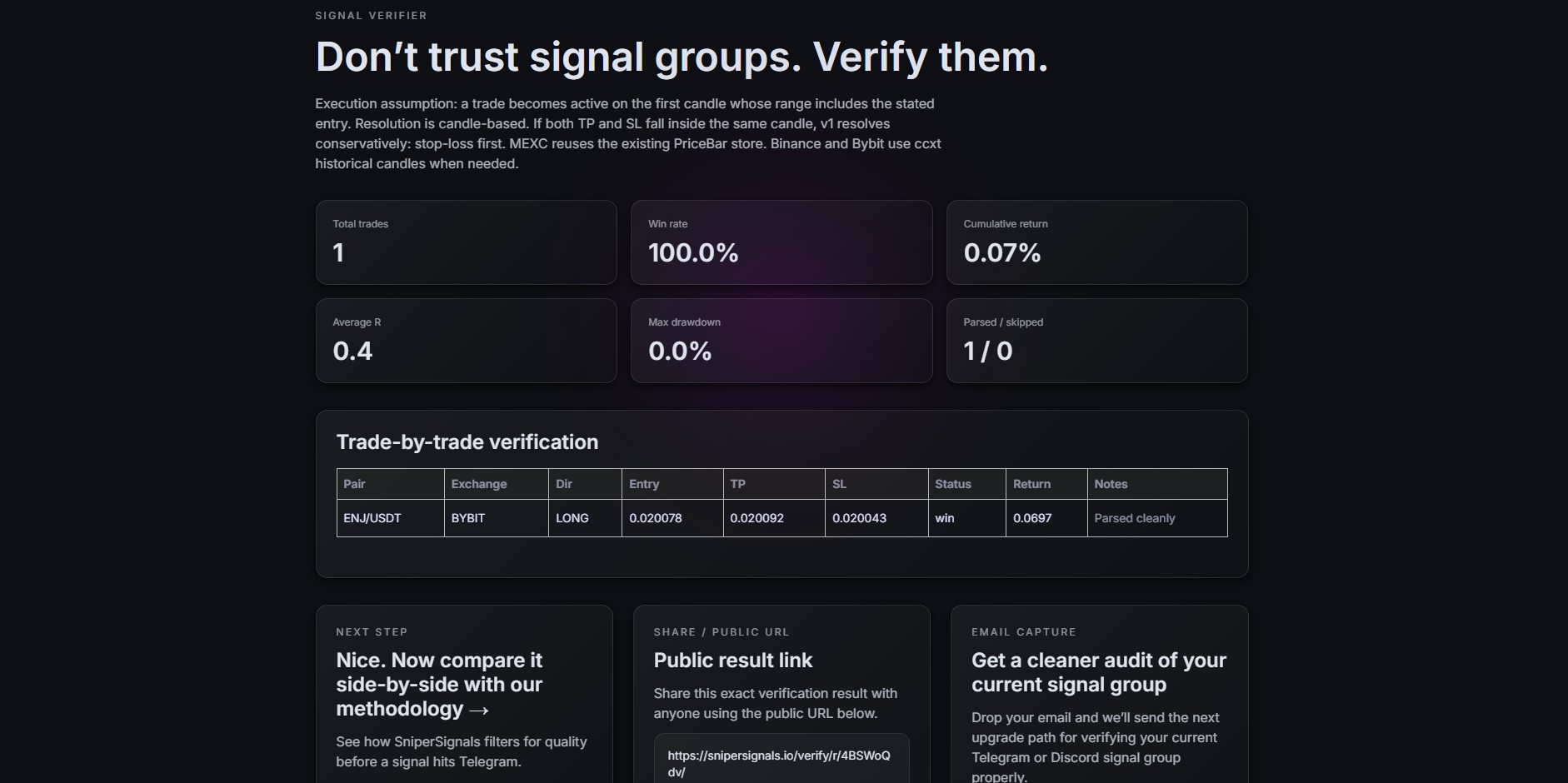
Start with four checks. First, inspect the public track record. Second, run example calls through Signal Verifier. Third, check whether the product explains when it stands aside through the live regime page. Fourth, only then compare pricing.
That order matters. Pricing should come after proof, not before it. If a service wants payment before evidence, the trust model is already backwards.
A strong signal product should still be useful to inspect even if you walk away without buying. That is the standard skeptical traders should use more often.
FAQ
How can I verify crypto signals before paying?
Check public resolved history, inspect how outcomes are labeled, and test sample signals against real market data before paying.
Why are screenshots weak proof?
Because they are easy to cherry-pick and usually strip away the timing and surrounding failed calls that matter for honest evaluation.
What should a public track record include?
Wins, losses, mixed outcomes, recent resolved history, and visible rules for how outcomes are classified.
What is the biggest red flag?
A provider that talks about accuracy but does not show hidden losses, public history, or a verifiable audit trail.
Judge the proof before the pitch
Use the public record, run the verifier, and inspect the workflow before you let pricing drive the decision.
Open Signal Verifier