Regime-Filtered Crypto Signals
A signal service that fires constantly is not automatically useful. In many cases, it is just pushing the filtering burden onto the trader.
Regime-filtered crypto signals aim to solve that problem by asking a harder question before a setup is surfaced: are current market conditions actually suitable for this type of signal?
SniperSignals is built around that principle. Instead of surfacing every possible setup, the system filters for conditions where the market structure is more consistent with the move being anticipated. When structure is weak, momentum is choppy, or the same zone keeps repeating, the product is designed to stand aside.
If you want regime filtered crypto signals instead of a constant blast of low-conviction alerts, the key idea is simple: the filter matters as much as the trigger. SniperSignals combines live condition checks, public signal history, and Telegram delivery into one workflow designed to be selective on purpose.
Start Free 7-Day TrialNo credit card required. No API keys.
What regime filtering means
Regime filtering checks the broader market environment before a signal is shown. Instead of asking only, “does this pattern match?” it also asks, “is the market in a condition where this type of pattern tends to follow through?” That second question is where many signal feeds fail. They treat every trigger as equally worth surfacing, even when the surrounding conditions are weak.
A better system suppresses signals when the surrounding structure is not supportive. If momentum is conflicting, if the environment is choppy, or if the market is still stuck in the same area that recently produced a signal, the right answer is often no alert at all. The trader never sees it because the product already decided that pushing it forward would add more noise than value.
This matters because market context changes how often patterns actually behave the way traders hope. A trigger that looks fine in isolation can still be poor in a weak environment. Regime logic exists to screen for that broader context before the setup ever reaches the user.
That is what makes regime logic useful. It does not promise perfect timing. It simply tries to remove setups that are less likely to be worth the trader’s attention in the first place.
Why standing aside is a feature
Most signal services treat silence as a problem. If the feed goes quiet, users start wondering whether they are still getting value. That pressure often leads services to keep posting simply to look active. The result is a busier feed, not a better one.
SniperSignals treats silence as a feature. Standing aside during weak or choppy conditions is one of the main ways the product avoids pushing low-conviction setups into the workflow. Fewer signals is the point, not a bug. A quiet period does not mean the system stopped working. It often means the system is doing the filtering job the trader would otherwise have to do manually.
That framing matters because it changes what users should expect. If you measure a signal service by raw volume, selective behavior can look unimpressive. If you measure it by whether it reduces bad noise, selective behavior becomes the product advantage.
In practice, silence is often the honest response to poor structure. A product that refuses to admit that usually ends up transferring the cost to the trader through more alerts, more false urgency, and more manual filtering pain.
How SniperSignals frames active versus suppressed conditions
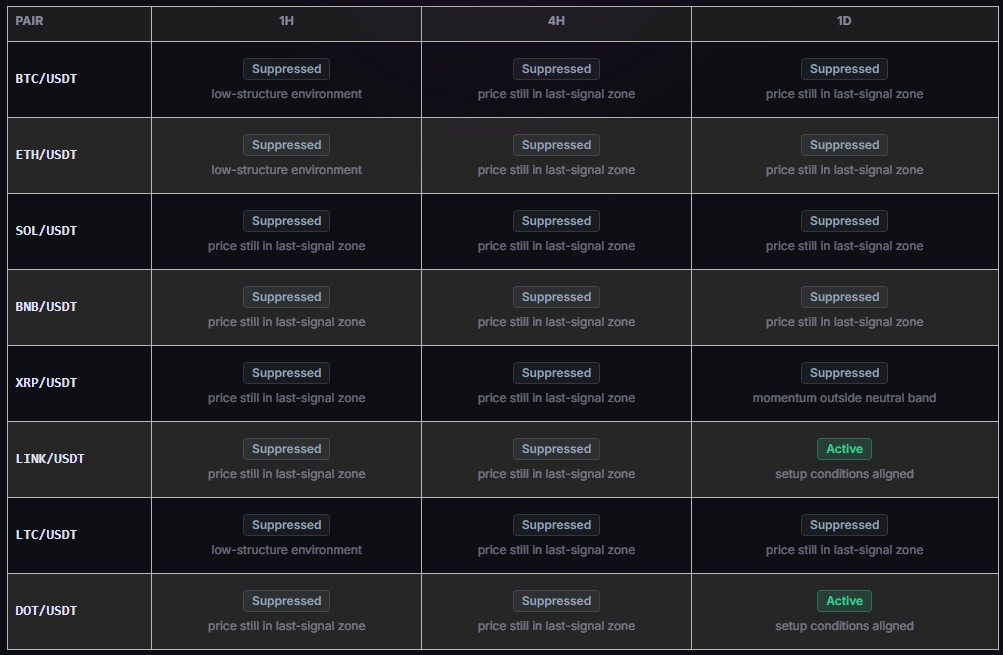
The public regime page shows a table of pairs and timeframes. Each cell is labeled Active or Suppressed with a reason. Active means setup conditions are aligned. Suppressed means the system is standing aside because the market does not currently fit what the engine wants to see.
That suppressed state is not hand-wavy marketing copy. It is tied to specific reasons the system can expose: price may still be sitting in the last signal zone, momentum may be outside the neutral range, or structure may simply be too weak. The point is to show what the engine is doing right now, not just claim that “smart filtering” exists somewhere behind the curtain.
This is also where the workflow connects back to the rest of the product. The same engine logic that determines whether conditions are active or suppressed is part of the same broader system that feeds the dashboard, powers Telegram delivery, and can later be compared against the public signal history to see how outcomes resolve over time.
That visibility is useful because it lets traders see the difference between theory and live behavior. The product is not merely saying it filters. It is exposing where it is active and where it is refusing to participate.
See the live regime page
The live regime page is public. Anyone can check which pairs and timeframes are currently active or suppressed without logging in. It shows what the system is doing right now, not just a marketing claim about what it does in theory.
That public visibility matters because it makes the selective model easier to evaluate. You can look at the current market state, compare it with the public signal history, and decide whether the workflow feels disciplined enough to justify a free trial.
It also gives the product a more honest posture. Instead of asking users to believe that filtering exists, it exposes the current active-versus-suppressed map in public. That is a better standard than generic claims about “AI quality control” with nothing inspectable behind them.
For traders comparing services, that kind of public state page is useful because it shows the operating philosophy in live conditions. You can see whether the system is permissive or selective, noisy or restrained, and then compare that with the historical outcomes shown elsewhere in the product.
See Live Regime StatusWho this is for and who it is not for
SniperSignals is a fit for traders who prefer fewer, higher-conviction setups and who understand that no signal is better than a bad signal. If you want the product to do some of the selection work before an alert reaches you, the regime-filtered model makes sense.
It is also a fit for traders who want to see a product stand aside honestly instead of padding the feed for appearances. Public state visibility is part of that trust layer.
Traders who already know that constant signal volume usually creates more work than clarity will likely understand this model fastest. The product is trying to remove marginal setups, not impress you with activity.
It is not a fit for people who want constant alerts or who measure a signal service by sheer output volume. If signal frequency is your main KPI, this workflow will feel too selective. But if you want cleaner operating conditions, public proof, and a workflow that still keeps your account separate through the no-API-keys model, this is the right kind of filter.
Explore the workflow before committing
Check the live regime page, inspect the public signal history, and see how selective delivery fits the product.
Start Free 7-Day TrialNo credit card required. No API keys. Explore the workflow first.